Training
SyberWorks: A Tailored Solution for Your Compliance Training
Compliance training is important for regulated industries. Learn how SyberWorks functions as a compliance training LMS.
Home / Blogs /
Discover how structured pharmaceutical compliance training improved outcomes by 70%, reduced audit risk, and ensured 100% training completion.
How Michael Carter, a Compliance Manager, overcame stalled training and audit risk by modernizing pharmaceutical compliance systems.
Read on to know what helped Michael regain control of compliance and training outcomes!
Pharmaceutical compliance is a non-negotiable requirement in an industry where patient safety, regulatory oversight, and operational integrity intersect. Yet, many pharmaceutical organizations still rely on fragmented systems that make compliance difficult to manage and even harder to sustain.
Michael, a 38-year-old compliance manager working at a mid-sized pharmaceutical manufacturer, understood this reality all too well. Despite his experience and diligence, training completion rates across his organization remained dangerously low. Manual spreadsheets, workshops, and disconnected documentation slowed everything down.
Despite Michael’s experience as a compliance manager, training completion rates across his organization remained dangerously low.
It was clear that Michael was struggling to enforce pharmaceutical compliance at scale without the right systems in place.
Continue reading to see how a pharmaceutical compliance management software led to a measurable transformation for Michael’s company.
Michael operated in an environment defined by evolving regulations, frequent audits, and zero tolerance for error. In the pharmaceutical industry, even minor compliance gaps can lead to fines, operational delays, or reputational damage. Yet his organization’s compliance processes had not evolved alongside regulatory expectations.
In the pharmaceutical industry, even minor compliance gaps can lead to fines, operational delays, or reputational damage.

Manual documentation and fragmented training records increase compliance risk and make audit preparation time-consuming.
Training assignments were tracked manually, SOPs were scattered across systems, and audit preparation required weeks of effort. This approach left little room for proactive compliance management and exposed the business to unnecessary risks. Without a structured pharmaceutical compliance framework, Michael’s role became reactive rather than strategic.
The situation was unsustainable. As regulatory scrutiny intensified, it was clear that maintaining compliance through manual oversight alone would only amplify risk rather than reduce it.
Michael initially tried to stabilize compliance using familiar stopgap measures. He scheduled mandatory weekend training sessions, condensed regulatory content into shorter formats, and relied on managers to manually confirm completion. Participation was inconsistent. Records were incomplete. None of these efforts produced a meaningful improvement in training outcomes.
The breaking point came with an unannounced regulatory audit. When auditors requested proof of role-based training completion and documented SOP acknowledgements, Michael could not produce a single, consolidated record. Training data was scattered across spreadsheets, email threads, and outdated files. Several critical gaps were identified within hours.
The audit concluded with a formal observation and a financial penalty, followed by immediate scrutiny from senior leadership. For Michael, the message was unmistakable. The issue was no longer effort or intent. It was infrastructure.
Manual processes could not scale, could not provide real-time visibility, and could not withstand regulatory review. Continuing with the same approach would only increase risk. At that moment, Michael stopped searching for quick fixes and began looking for a system that could enforce pharmaceutical compliance consistently, transparently, and at speed.




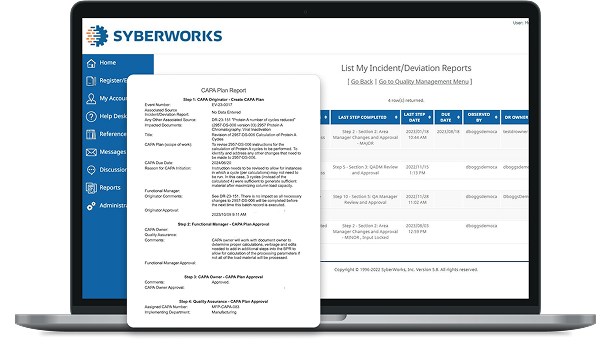
Michael’s turning point came when he adopted SyberWork’s centralized pharmaceutical compliance management software designed to automate and integrate training, documentation, and quality workflows. Instead of reacting to compliance failures, SyberWorks LMS enabled proactive control.

Pharmaceutical compliance management software replaces fragmented systems with automated training, controlled SOPs, and faster audit-ready reporting.
Training assignments were automatically linked to employee roles, reminders ensured timely completion, and SOPs were maintained within a single source of truth. Audit preparation shifted from weeks of manual work to minutes of reporting.
The impact was immediate and measurable. Training completion rates reached 100%. Administrative workload dropped by 50%. Audits became predictable rather than stressful. For the first time, Michael had full visibility into compliance performance across the organization.
The breakthrough was not just technological, it was strategic. By implementing pharmaceutical compliance management software, Michael moved from firefighting to future-proofing.
Compliance was no longer a burden; it became a structured, reliable process.

100% training completion rates with automation
100% audit-readiness achieved in minutes
50-75% reduction in administrative tasks thanks to automation
Prepare or produce audits within minutes instead of weeks
Reduced Risks, avoid potential regulatory fines and lawsuits
Michael’s experience shows that pharmaceutical compliance cannot be sustained through effort alone. It requires structure, visibility, and systems designed for regulatory reality. By moving away from fragmented tools and manual oversight, his organization established a repeatable, audit-ready approach to compliance training.
Training completion rates imroved to 100%, administrative effort was significantly reduced, and audits shifted from reactive events to predictable processes. More importantly, compliance became embedded in daily operations rather than treated as a periodic obligation.
What differentiated this outcome was not just automation, but integration. Training, document control, and quality workflows operated as a single system, ensuring that regulatory changes and corrective actions translated directly into timely employee training.
Get audit-ready in weeks, and achieve 100% training completion with Syberworks’ pharmaceutical compliance management software.

Learn any time, any place. Highly tailored to your organization’s needs.


